Retrograde Motion and Epicycles
This section is required only for Edexcel GCSE students.
One of the biggest challenges the ancient geocentric model faced was the peculiar movement of some planets in the night sky.
Retrograde Motion: The Apparent Backward Dance
If you observe the planets like Mars, Jupiter, or Saturn over several weeks or months, you’ll notice something strange. Most of the time, they move steadily in one direction across the sky against the background of the ‘fixed’ stars (this is called prograde motion). However, periodically, these planets appear to slow down, stop, move backwards for a while (this is retrograde motion), and then slow down again, stop, and resume their ‘normal’ forward motion. In fact, this apparent backward motion can be observed for all planets, although there are some practical difficulties in observing it for certain ones.
This ‘loop-de-loop’ or apparent backward movement was a huge puzzle for ancient astronomers who believed in the geocentric model – that everything orbited Earth in perfect circles. If everything was simply orbiting Earth, why would planets occasionally reverse direction? This observation was difficult to reconcile with a simple Earth-centred view.
Epicycles: An Ingenious (but Complex) Solution
To explain this puzzling retrograde motion while still maintaining the core belief that Earth was stationary at the centre of the universe, ancient astronomers, most notably Ptolemy (around 100-170 AD), developed a very clever but ultimately complex system involving epicycles.
- The Idea: Instead of a planet orbiting Earth directly in a single large circle (called a deferent), Ptolemy proposed that a planet actually moved in a smaller circle called an epicycle. The centre of this smaller epicycle, in turn, moved along the larger deferent circle around the Earth (see Figure 1).
- How it Explained Retrograde Motion: Imagine the planet moving along its small epicycle. When it was on one side of the epicycle, its motion combined with the deferent’s motion to appear forward. But when it was on the other side of the epicycle, the planet’s motion along the epicycle was in the opposite direction to the deferent’s motion around Earth. This combination of movements made the planet appear to move backward for a period, even though it was always moving forward along its epicycle and deferent.
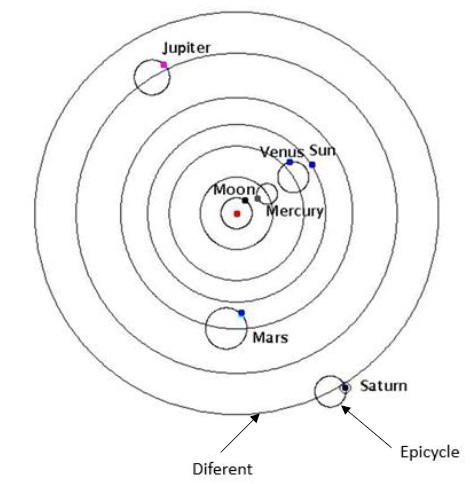
Ptolemy’s model, with its deferents and epicycles (and even smaller epicycles on top of those, as well as offsets called equants and eccentrics to refine accuracy – students do not need to learn about equants and eccentrics for their GCSE exam), was incredibly intricate. It could predict planetary positions with reasonable accuracy for its time, and it remained the dominant model for over 1400 years.
However, the increasing complexity of the epicycle system – adding more and more circles to explain new observations – ultimately contributed to its downfall. When Copernicus proposed the heliocentric model, it offered a much simpler and more elegant explanation for retrograde motion:
Heliocentric Explanation of Retrograde Motion
In the Sun-centred model, retrograde motion is simply an optical illusion. It occurs due to the relative speeds of Earth and the other planets, combined with our changing perspective:
- For outer planets (like Mars), Earth orbits the Sun faster. As Earth ‘overtakes’ a slower-moving outer planet, the perspective from Earth makes the slower planet appear to move backward against the distant background stars for a brief period – much like a slower car appears to move backward relative to the background when a faster car overtakes it on a multi-lane highway.
- For inner planets (like Mercury and Venus), which orbit the Sun faster than Earth, their apparent retrograde motion occurs when they ‘overtake’ Earth as they swing between Earth and the Sun.
Observational Difficulty for Inner Planets
We often associate apparent retrograde motion more with outer planets (especially Mars) because, for Mercury and Venus, their retrograde loops occur when they are relatively close to the Sun in our sky (often during the day, or very close to sunrise/sunset). This makes them very difficult to observe clearly, as the Sun’s glare can hide them.
The shift from the complex, Earth-centred epicycle system to the simpler, Sun-centred explanation of retrograde motion was a powerful piece of evidence supporting the heliocentric model and marked a significant step in our understanding of the Solar System.
Useful YouTube Videos
- Video showing how Mars appears to move along the sky from our view from Earth (Video courtesy of Tad Thurston)
- Video showing how the geocentric model, using deferent and epicycle of Mars, can explain the apparent retrograde motion (Video courtesy of Gregory Locker)
- Video showing how the heliocentric model explains the apparent retrograde motion (Video courtesy of Interplanetary)
- Another video showing the view from Earth and how heliocentric model explains the apparent retrograde motion (Video courtesy of Nooch 86)
These videos are shared here to support student learning on this topic.